
By Kaitlyn Ashner, RDN, LD · Updated November 19, 2026
You ate the same breakfast every day for months. Then one morning, it just stopped working.
If that sounds familiar, you're not broken. You just hit the end of a hyperfixation meal.
A hyperfixation meal is a food you eat over and over, often for weeks or months, because it's predictable and takes one decision off your plate. When it suddenly stops working, that's your sensory system shifting, not a failure. Keep a rotation list, notice what changed, and know these foods often come back.
Write down 3 foods that have worked for you before. That's it. That counts.
My Frosted Mini-Wheats Year
I'm a registered dietitian. I'm also autistic and ADHD. As an ADHD nutritionist who has lived this, I can tell you: for about a year, I ate Frosted Mini-Wheats for breakfast every single day. Curious how your own eating lines up? Try my free 1-minute ADHD eating self-check.
It was predictable. Same texture, same mouthfeel, every time. And it meant one less decision on busy mornings getting ready for work.
It also had a real job. It got me through my first 3 to 4 client appointments without needing a snack.
Then one morning, with no warning, it felt like too much chewing. Too much effort to get down. I felt panicked, and honestly a little heartbroken. I'd lost such a reliable plan.
So I reached for an Orgain protein shake. Quick, portable, a totally different texture, and barely any chewing.
This isn't new in my family, either. My mom ate corn flakes with a cut-up banana every morning for 10 years, and my family gently teased her for it.
These days, I don't panic. I know these foods tend to come back around, and I have a rotation to lean on in the meantime.
What Is a Hyperfixation Meal (and How Is It Different From a Safe Food)?
A hyperfixation meal is a short, intense stretch of eating one food, meal or combo most of the time. A safe food is a long-term, reliable food your nervous system trusts.
Both matter. They just play different roles.
If a long-time safe food changed on you, read My Safe Food Stopped Feeling Safe.
Is Food Hyperfixation Normal?
Yes. In my practice, eating the same food on repeat is very common for ADHD and autistic adults.
It isn't a flaw. It's your brain finding something that works.
Why Do Hyperfixation Meals Happen?
Short answer: your brain found something that makes eating easier. Here's what's usually going on.
1. One Less Decision 🧠
Every food choice takes energy. When you already know what you're eating, that's one less decision stacked on top of everything else in your day.
For ADHD and autistic brains, that saved energy is a big deal.
2. Predictable Sensory Input 🥣
Same texture, same mouthfeel, same taste, every time. Your nervous system knows exactly what's coming.
No surprises means less stress around eating.
Research backs this up. A 2025 study of 961 adults found that sensory sensitivity and wanting things to stay the same both predicted more selective eating in autistic and ADHD adults (Bayoumi et al., 2025).
3. It Feels Good to Your Brain 🎯
ADHD brains often lock onto things that feel rewarding and interesting. Food can be one of them.
When a meal hits just right, your brain wants it again. And again.
4. It Does a Real Job ⏰
A hyperfixation meal often solves a problem. For me, Mini-Wheats meant I could get through my morning appointments without a snack.
That's not a quirk. That's a strategy.
5. Then Your Sensory Needs Shift 🔄
Here's the hard part. One day, the same food can suddenly feel like too much chewing, the wrong texture, or just "no."
There's usually no warning. That's not you doing something wrong. It's biological, not moral.
Studies of neurodivergent adults link stronger sensory sensitivity to more avoidant and restrictive eating (Thomas et al., 2025; Cobbaert et al., 2026).
Eating the same thing every day isn't a character flaw. It's a strategy your brain found to make eating possible.
Hyperfixation Meal Examples: What It Can Look Like
The hyperfixation foods I hear about most:
- Chicken nuggets
- Potatoes and french fries
- Chips
- Mac and cheese
- White bread or toast
- Hamburger and french fries
- Bagel with cream cheese
- Grilled cheese sandwich and soup
And what clients say when one stops working:
- "What do I do now? This was one of my last doable options."
- "I'll probably just go without eating then."
That last one is why this matters. When a go-to food ends, some people stop eating instead of finding something new. Let's make sure you have a plan before that happens.
Myth: Eating the Same Foods Every Day Is Bad for You
The most common thing people hear: "That's so unhealthy." Usually about nuggets, fries or a boxed mac and cheese.
Here's what I look at instead: how much processing a food went through, and what nutrients it still carries. Canned, frozen and shelf-stable foods still hold onto nutrients.
Even the USDA counts vegetables whether they're fresh, frozen, canned or dried (USDA MyPlate). Potatoes are on that list too, as a starchy vegetable.
Take french fries. They come from potatoes, which give you starch for energy plus potassium.
Processed doesn't mean "bad." A lot of the time, it means doable.
The only truly "bad" foods are spoiled, expired or dangerous ones. Try asking: "How will this food benefit me?"
When a Hyperfixation Meal Ends: What to Try
Save or screenshot this chart.
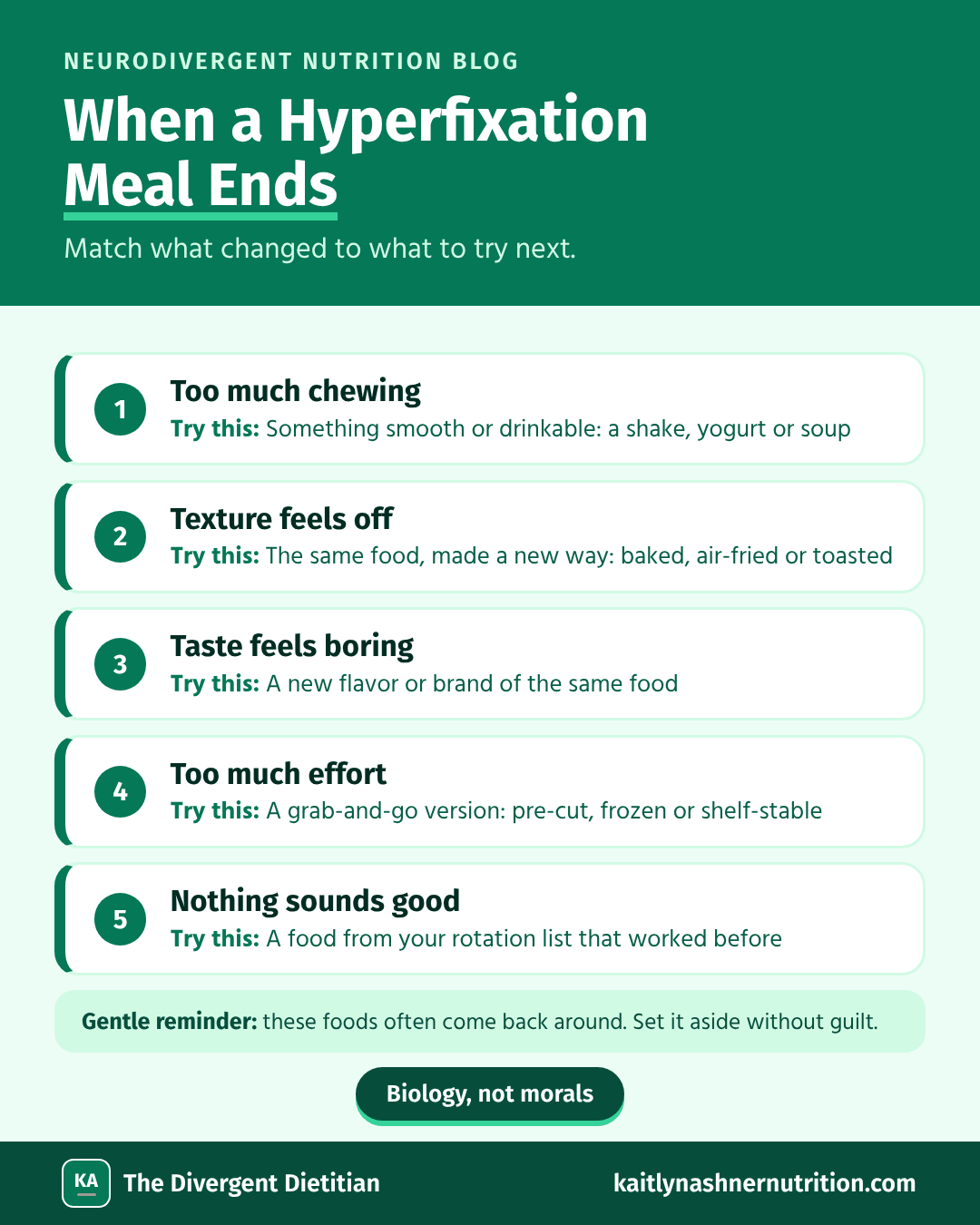
Low-Spoon Ways to Handle the End of a Hyperfixation Meal
Keep a Rotation List 📝
Write down foods and meals that have worked for you in the past. When one stops working, you're not starting from zero at the fridge.
Keep it on your phone or on the fridge door, wherever you'll see it.
Name What Changed 🔍
Was it the chewing? The texture? The effort? Pinpointing the sensory piece that stopped working tells you what to try next.
Every brain breaks at a different step. Where does your chain break?
Change the Prep Method 🍳
The same food can feel completely different depending on how it's made. A fresh apple, applesauce and a baked apple chip are three different experiences.
Try the same food in a new form before giving it up.
A big switch can be easier than a small tweak. When cereal felt like too much chewing, I went to a shake: totally different texture, almost no chewing.
Trust That Foods Come Back 🔁
In my experience, hyperfixation foods often come back into play. Not on a schedule, but they do.
Set it aside without guilt. It might be back on your plate in a few months.
Losing weight without trying, more tiredness or moodiness than usual, or your list of doable foods shrinking fast. These can be signs of ARFID or another eating disorder, and support helps. If you're in crisis, call or text 988.
You Don't Have to Figure Out Your Next Meal Alone
My goal for you is that a food ending doesn't mean going without. It means reaching for a plan you already have.
Together, we'll:
- Build a rotation list from foods you already eat
- Find which sensory piece changed, so we know what to try next
- Make a backup plan for mornings and low-spoon days
No food rules. No shame. Most clients pay $0 with insurance (see which plans I take), I see clients virtually in 27 states, and you can start in 1–2 weeks.
Keep reading: My Safe Food Stopped Feeling Safe · ARFID Safe Foods List for Adults · ADHD Forgetting to Eat
Low on spoons right now? Grab the free Low-Spoon Staples Guide or the ADHD Eat-Reminder Checklist.
Not sure where your eating gets stuck? Take the free 1-minute ADHD Eating Self-Check.
Hyperfixation Meals: Quick Questions
What is a hyperfixation meal?
A food, meal or combo you eat over and over, often several times a day, for weeks, months or longer. It's common for ADHD and autistic people.
Is a hyperfixation meal the same as a safe food?
Not quite. A hyperfixation meal is a short, intense phase. A safe food is a long-term, reliable food your nervous system trusts.
Why did my favorite food suddenly stop working?
Sensory needs can shift without warning. A texture or amount of chewing that felt fine can suddenly feel like too much. It's not your fault.
Is it bad to eat the same thing every day?
No. Repeating meals saves energy and decisions. Canned, frozen and shelf-stable foods still carry nutrients.
Is food hyperfixation an ADHD or autism thing?
In my practice, it's common with both. It often comes down to fewer decisions and predictable sensory input.
What do I eat when my hyperfixation meal ends?
Start with your rotation list. Then try the same food made a different way.
Will my hyperfixation food come back?
Often, yes, though there's no set timeline. A rotation list helps in the meantime.
About the Author
Kaitlyn (Kait) Ashner, RDN, LD (they/she) is The Divergent Dietitian. They are an autistic ADHD dietitian who helps neurodivergent adults and people with complex bodies make eating easier, virtually in 27 states.
This post is for education only and isn't medical advice. Talk with your own care team about your needs.

📤 Share this post