
By Kaitlyn Ashner, RDN, LD · Updated November 21, 2026
You tried recovery.
Maybe more than once.
And it felt like you were the one who failed.
You didn't fail. In my practice, I see traditional recovery miss the mental load of feeding yourself several times a day. For many neurodivergent adults I work with, that load leads to setbacks. Recovery can work with your brain, using safe foods, visual plans and low-spoon supports.
Eat one safe food you already have at home. That's it. That counts.
Why this is personal for me
I'm a registered dietitian. I'm also AuDHD.
As a neurodivergent eating disorder dietitian, I know how different recovery looks when your brain works differently.
I have my own texture struggles, so I never treat a sensory need like a character flaw.
My brain is wired like yours. I build recovery that works with it, not against it.
Traditional treatment was designed for a neurotypical brain. We can keep the parts that helped, and bring your neurodivergent wiring into recovery so it feels realistic and honors your needs.
Why recovery looks different for neurodivergent adults
Autism and anorexia often overlap.
A recent meta-analysis found that about 29% of people with anorexia scored above the screening cutoff for autism (Inal-Kaleli et al., 2025).
1. The mental load of feeding yourself 🧠
In my practice, I see traditional recovery put little focus on executive function.
But feeding yourself several times a day, every day, takes planning, starting and finishing.
2. Why it matters 🔁
When that load isn't worked through, I often see it lead to setbacks.
It's a gap in the plan, not a lack of effort.
3. Sensory needs 👅
Some foods are hard because of texture, smell or taste.
That can be different from fear driven by an eating disorder.
A setback isn't a failure. It's information about what the plan was missing.
What It Can Look Like
Here's what I often hear from neurodivergent adults in recovery:
- "I know what to eat. I just can't get started."
- "Eating that many times a day wears me out."
- "I don't know if I avoid this food because of fear or because of the texture."
- "I feel like I failed treatment."
Myth: "You failed treatment"
Treatment may not have included your unique wiring and needs.
That's not on you.
Now, in an affirming space, we can build on that traditional foundation.
And add what works best for your brain.
Traditional vs Neurodivergent-Affirming Recovery
Here's how the two approaches often differ, side by side.
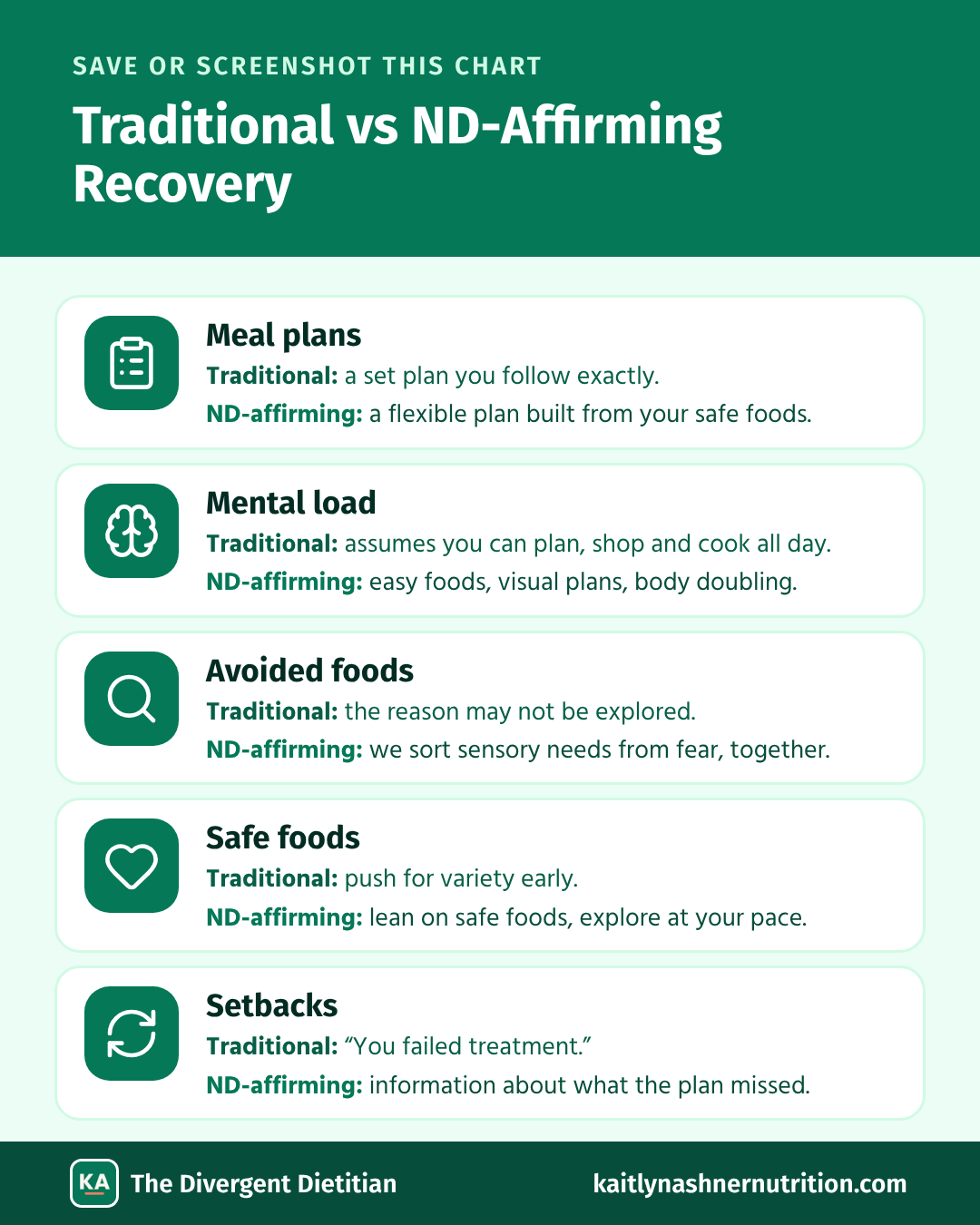
Save or screenshot this chart.
Sensory need or ED fear?
I always look closely at why a food is being avoided.
We explore your sensory experiences with food together, to find the differences.

Save or screenshot this chart.
ADHD and Binge Eating: Why the Cycle Happens
ADHD and eating disorders often show up together.
A review of 12 studies found people with ADHD had about 4 times the odds of binge eating disorder (Nazar et al., 2016).
1. The day starts empty ⏰
Time blindness and hyperfocus can push the first meal to mid-afternoon.
2. Hunger hits all at once 🌙
By evening, your body is catching up. That isn't a lack of willpower. It's biology after a long gap.
3. Shame tightens the cycle 🔁
Many people respond by restricting more the next day. In my practice, I often see that make the next evening harder, not easier.
Catch-up eating after a long gap isn't a failure. It's your body asking for fuel it didn't get earlier.
What helps instead:
- Eat something earlier, even something small
- Keep a no-prep food where you work
- Anchor eating to something you already do, like meds or your first meeting
- Drop the "make up for it" rules the next day
If binge eating is part of your story, you're welcome here. Recovery support covers it too.
How I use safe foods in recovery
I help people lean into their safe foods to support recovery and refeeding.
At the same time, I gently encourage some food exploration.
The goal is food freedom and flexibility, at your pace.
Low-spoon supports that make recovery doable
🥫 Convenience foods
They're a foundation, not a shortcut. What matters most is that you eat.
Try: frozen meals, rotisserie chicken, pre-cut fruit or a shake you already like.
🖼️ Visual plans
A visual plan can cut the mental load of remembering what to eat.
Try: a photo menu of 5 go-to meals taped inside a cabinet door.
👥 Body doubling
Eating alongside someone, in person or on a call, can make starting easier.
Try: a standing video call with a friend at lunch.
🧩 Mix-and-match meals
Combine items you already like into simple meals.
Try: pick 1 protein, 1 carb and 1 fun food.
📦 Meal kits or meal services
They can take planning and shopping off your plate.
Try: a service with fewer steps, or grocery pickup with the same list each week.
🍽️ Eating out strategically
Planning meals out can be a real part of recovery.
Try: look at the menu ahead of time and pick before you go.
Keep your go-to safe foods easy to see and reach. Out of sight can mean out of mind.
🔍 Where does your chain break?
Is it remembering to eat? Getting started? Shopping? Sensory overload?
Finding the weak link shows us where to start.
What Our First Session Looks Like
You don't have to prove anything or explain your brain to me. I believe you.
Here's what we usually do:
- Talk about what feels hardest right now
- Look at what has and hasn't worked before
- Map your safe foods and your energy patterns
- Pick one or two small, doable next steps
Working with your care team
I believe recovery works best as a team.
If you'd like, I can:
- Send updates to your care team
- Join care coordination calls
- Communicate by fax or email
Recovery that works with your brain
My goal is recovery that fits how you think, feel and live.
Together, we'll:
- Lighten the mental load of feeding yourself
- Lean into safe foods while gently exploring
- Work alongside your therapist and care team
No food rules. No shame. Most clients pay $0 with insurance (see which plans I take). I see adults by telehealth in 27 states, usually within 1 to 2 weeks.
Keep reading: ARFID in Adults · I Should Be Able to Feed Myself by Now · ARFID Safe Foods List · Nutrition for Trans People on HRT
Low on spoons right now? Grab the free Low-Spoon Staples Guide or the ADHD Eat-Reminder Checklist. Starting or already on HRT? There's a free Preparing for HRT checklist too.
ND Eating Disorder Recovery: Quick Questions
Why is ED recovery harder for neurodivergent adults?
In my experience, traditional recovery often misses the executive function load of eating several times a day.
Can I keep my safe foods in recovery?
Yes. In my practice, safe foods are part of recovery, with gentle exploration over time.
How do I tell sensory needs from ED fear?
We explore why a food is avoided, together, at your pace.
Do you work with my therapist?
Yes. I can send updates, join care calls and communicate by fax or email.
Can ADHD cause binge eating?
ADHD is linked to higher odds of binge eating disorder. Time blindness and long gaps without food can feed the cycle.
Do you help with binge eating?
Yes. Recovery support includes binge eating, restriction and the cycle between them.
About the Author
Kaitlyn (Kait) Ashner, RDN, LD (they/she) is The Divergent Dietitian. They make eating easier for neurodivergent brains and complex bodies, including adults in eating disorder recovery.
This post is education, not medical advice. If you're in crisis, call or text 988.

📤 Share this post